

Research · Nov 6, 2026
Towards Foundation Decision Models: Drex
Nischay Dhankhar, Alisher Amantay, Zhanibek Datbayev, Darkhan Akhmetov, Yash Shah, Nurmukhamed Ubaidullayev, Raman Saparkhan, Dos Baha, Abulhair Saparov
Towards Foundation Decision Models: Drex
A lot of what AI does in production isn't writing. It's choosing: which team gets this ticket, which button the agent clicks next, whether this passage answers the question. The usual way to do that is to ask a large model, let it think, and parse an answer out of its text. That's slow, costly, and gives different answers to the same input.
A decision model skips the text. You pass a context, a question, and your options, and one forward pass returns a probability for every option. It can't answer outside the set you gave it.
Today we're publishing the technical report on Drex, our family of four open decision models, and on how we built the largest of them, Drex Max. It is one of the first in-depth technical reports on how decision models behave. Here are a few results we're most excited about.
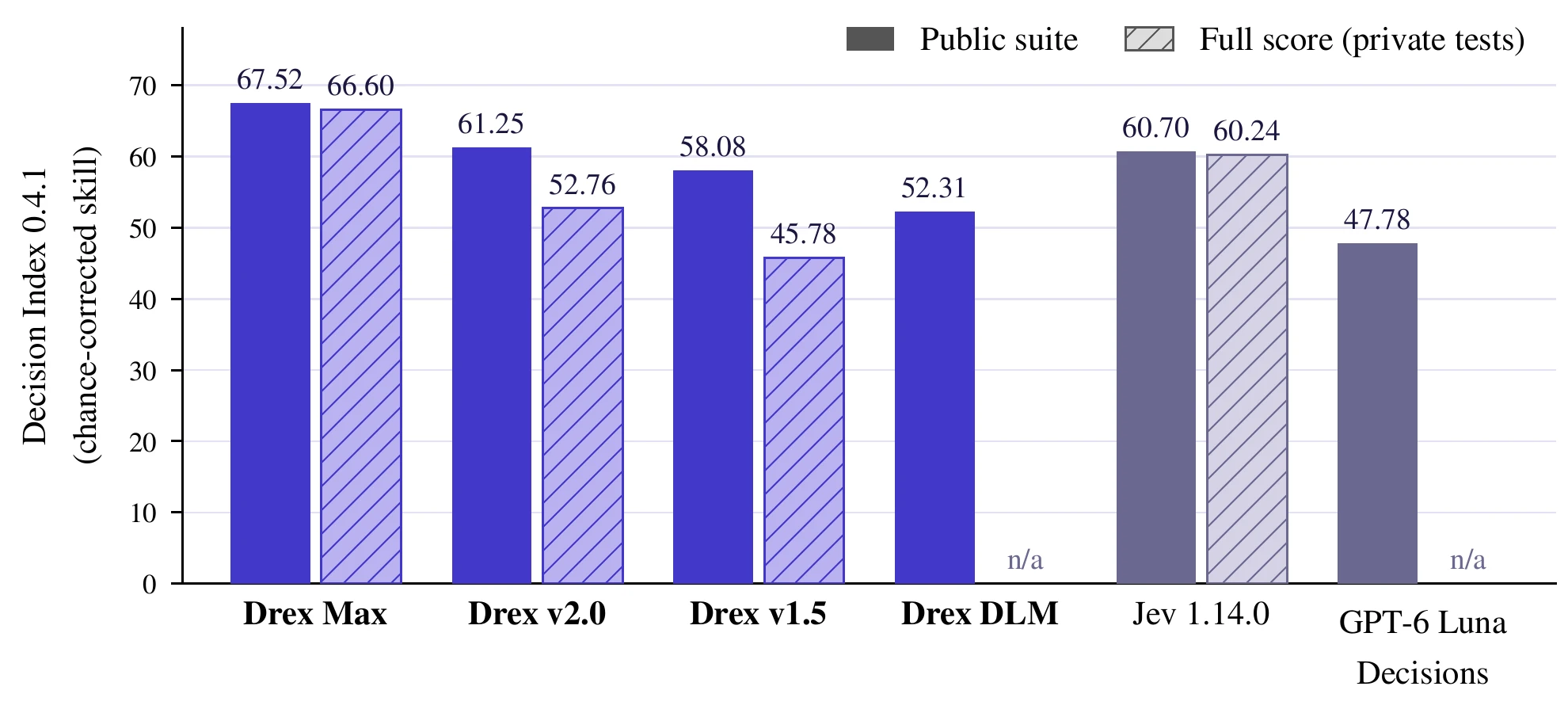
A new state of the art, and it holds on unseen tests. Drex Max leads the decision models we compare on Decision Index 0.4.1, with 67.52 on the public suite against 60.70 for Jev 1.14.0. When the private tests are added, its score drops less than a point, demonstrating strong generalization capabilities.
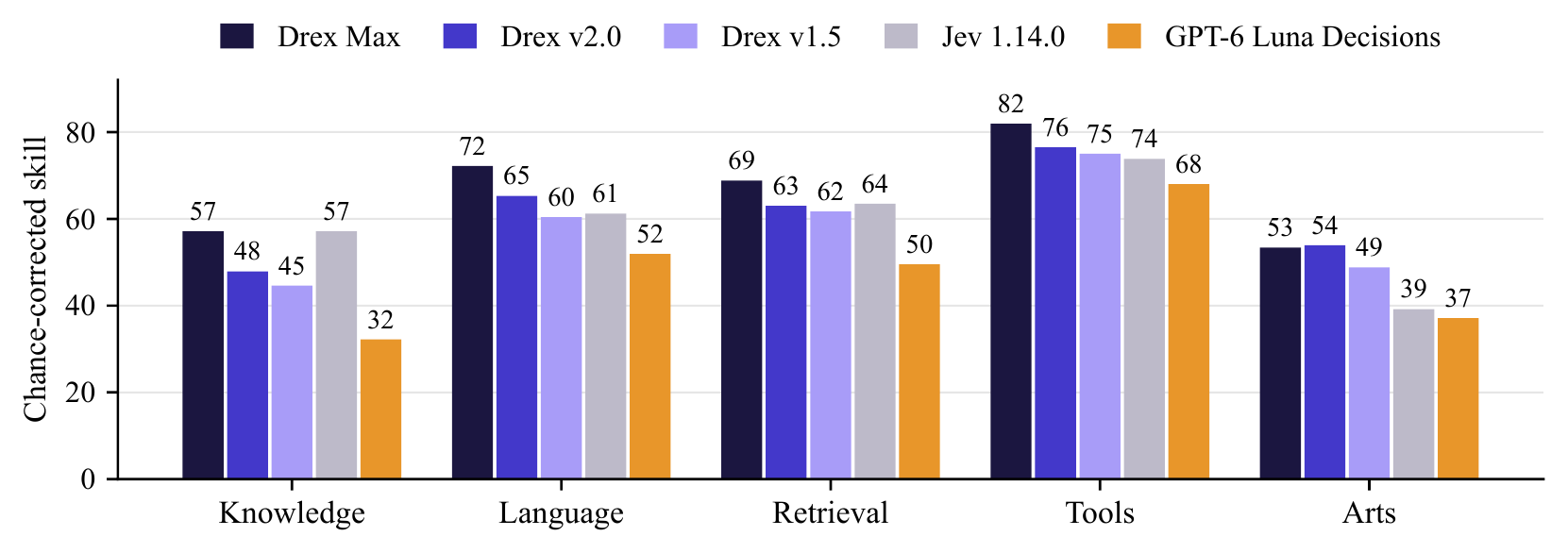
Independent results agree. On the Artificial Analysis Decision Index, Drex Max scores 64, within two points of the three leading decision models.
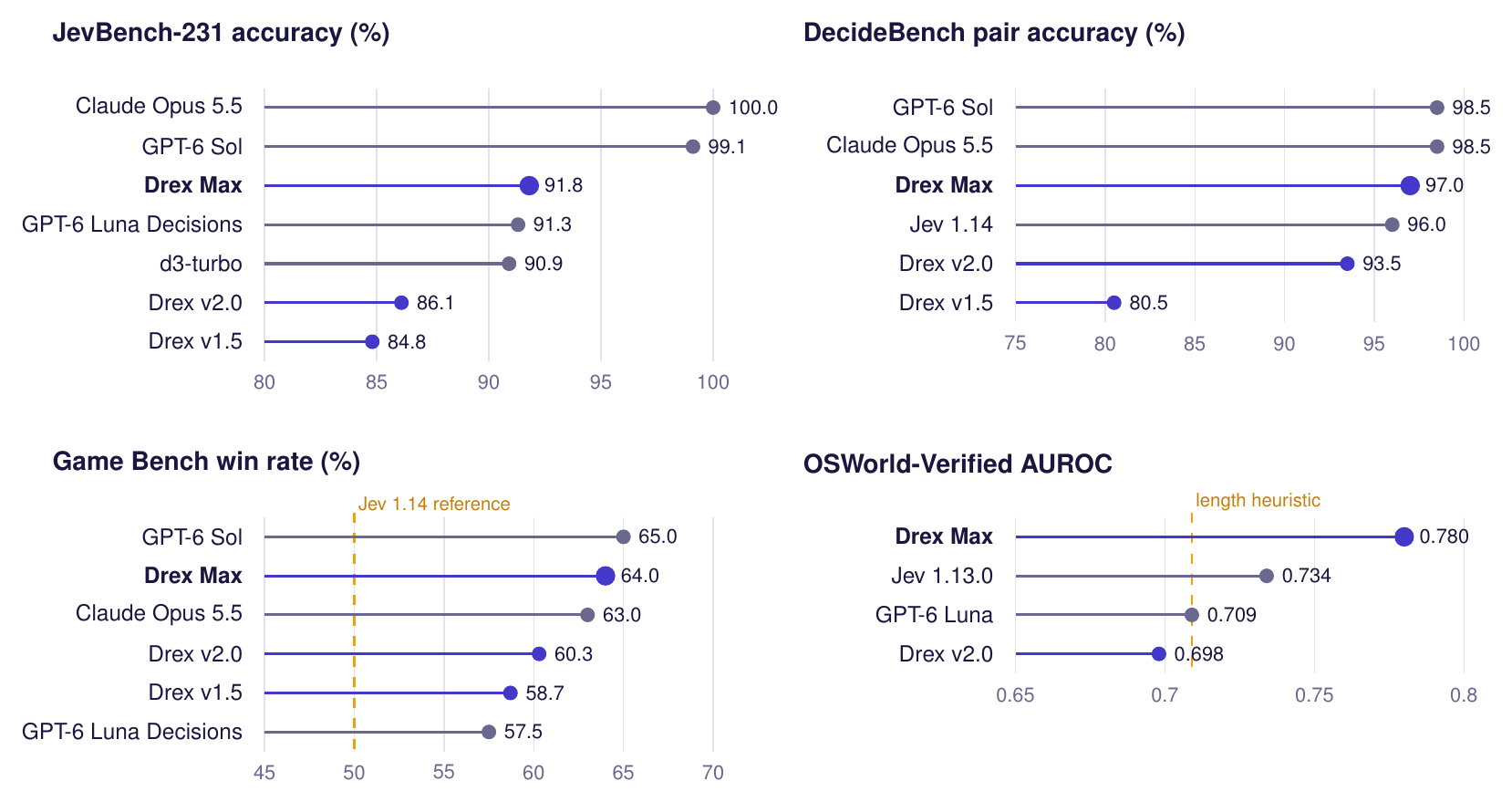
Frontier accuracy, without the wait. On Decision Bench v4, with raw image input, Drex Max is statistically tied with d3-turbo and GPT-6 Sol and 1.6 points behind Claude Opus 5.5. It answers a typical request in 183 ms. GPT-6 Sol takes about 2 seconds and Opus about 3.5.
It holds up on other decision benchmarks too. Drex Max is the most accurate decision model on DecideBench, close to the top decision models on JevBench-231, and the only model that clearly beats a transcript-length heuristic when judging OSWorld runs.
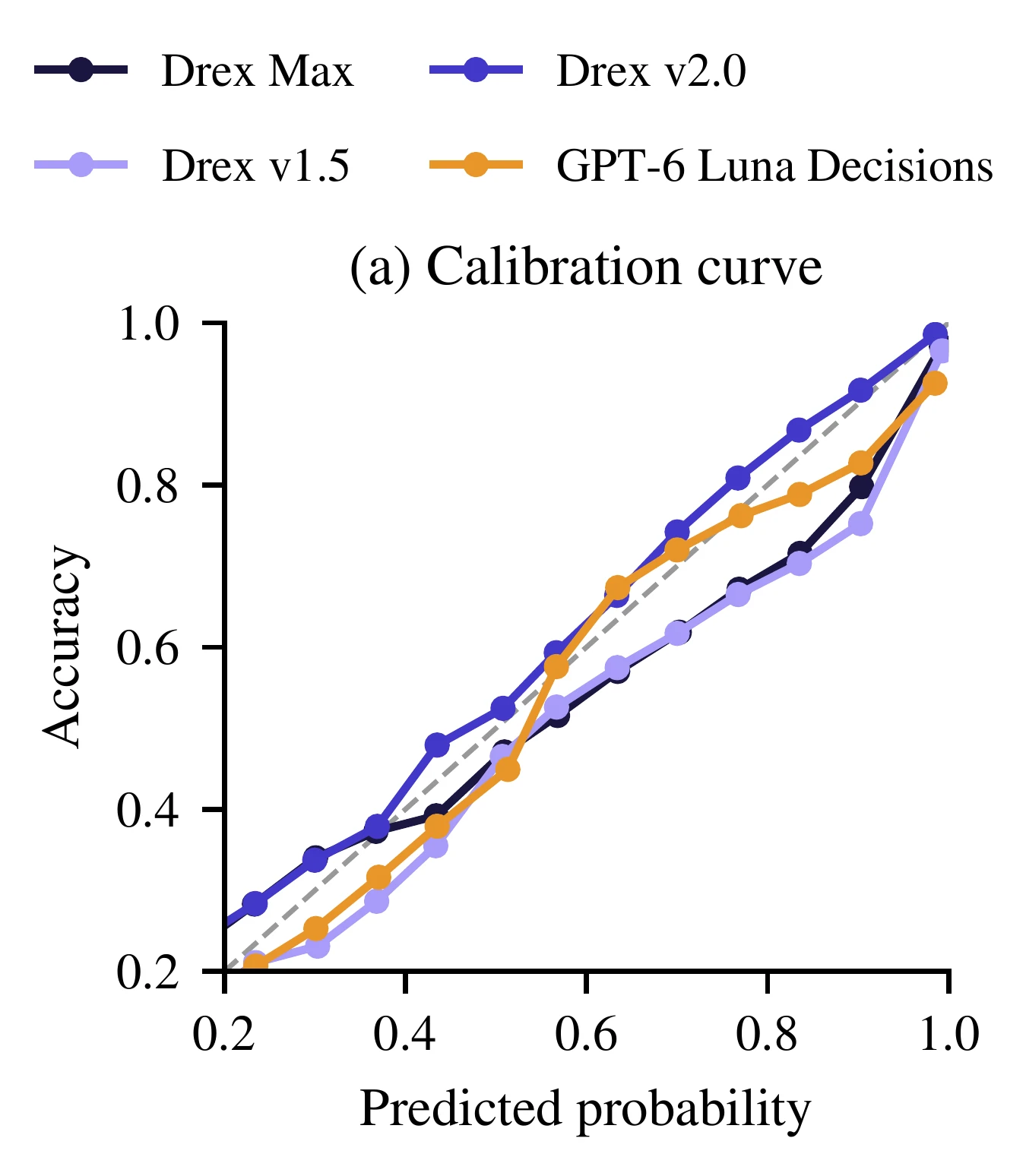
Calibrated confidence. Drex models return a probability for every option, calibrated so that confidence tracks how often the model is right. When Drex Max is at least 93% sure, it is right 97% of the time. So you can rely on that confidence when building workflows and pipelines.
Answer consistency. When the answer options in a prompt are randomly reordered, only 4.3% of Max's answers change, and accuracy barely moves. The answers that do flip are mostly ones the model already flagged as unsure.
It reads the image, not a description of it. On image-only questions, Max is right 63% of the time from a text description of the image and 98% from the raw image.
In the paper
The report covers how every Drex model is built. The three pointer models encode the input once and score every question's options with a small pointer head. Drex Max is a 27B multimodal model with bidirectional attention and a linear readout head over the option codes.
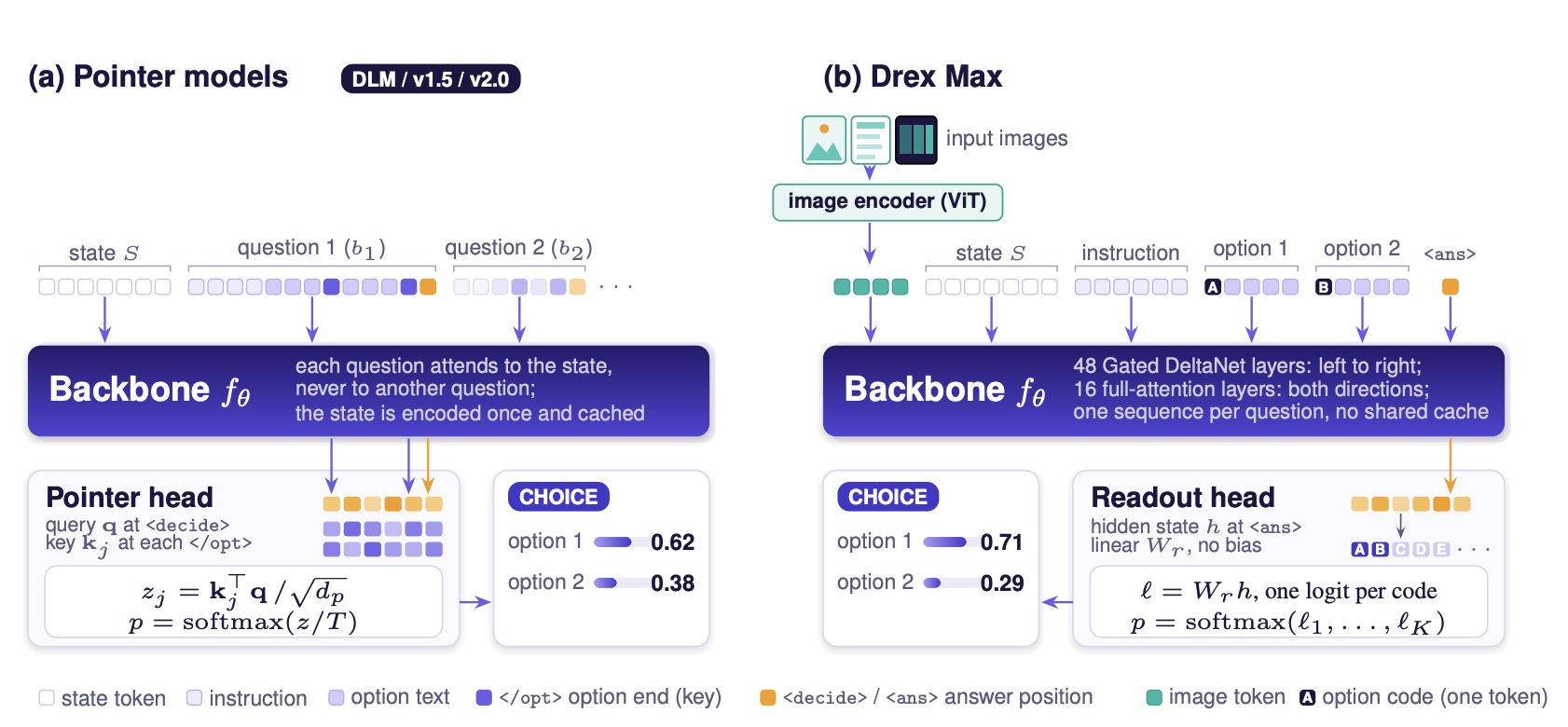
The report also covers the training recipe, including RLAF, which rewards verified answers adjusted by a judge's probabilities without drifting from the supervised model, and adds 2 index points over supervised training alone. It closes with full evaluations against decision-specialized and frontier models, how we serve the models in production, and the limitations we still see, closed-book knowledge first among them.
All four models are open source. Weights and inference code are on GitHub and Hugging Face, and Drex Max is served through the Drex API.